Vape atomiser: five generations of a key part
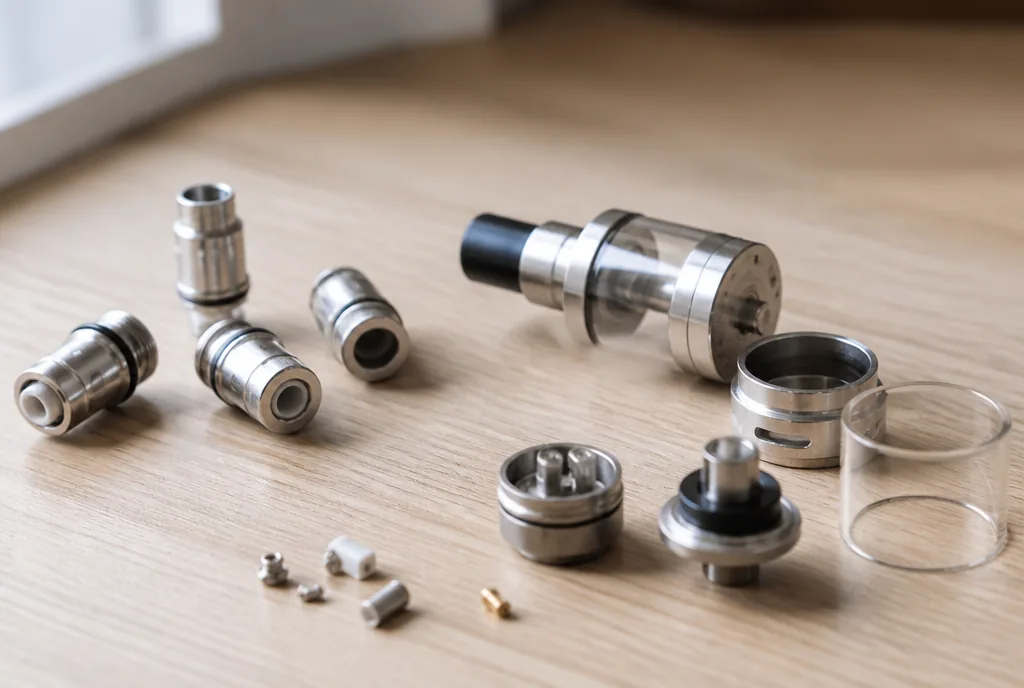
The word now covers objects that have almost nothing in common: a two millilitre pod you clip into place, a tank thirty millimetres across, a bare deck onto which you screw your own wire. That confusion is not an accident of vocabulary. It comes from twenty years of layering, in which each new family of vape atomiser kept the name of the one it replaced without ever quite erasing it. British shops still stock all five families side by side, which is why the same word means five different things depending on which shelf you are standing in front of.
What a vape atomiser does inside the device
A vape atomiser is the element that turns liquid into vapour. It brings together three functions: a reserve of e-liquid, a wick that carries it, and a coil heated by the battery. Everything else, a clear tank, a clip in pod or a rebuildable deck, is simply a different way of arranging those three functions.
That minimal definition explains why the word survived every change in hardware. The formats changed five times over, the function never did. It also explains why a shop assistant and a forum regular can use the same term and mean completely different objects without either of them being wrong.
2003, the separate part of the early days
The modern e-cigarette rests on a patent filed in 2003 by Hon Lik, whose first device was manufactured in 2004 in Shenyang under the Ruyan name. The Chinese pharmacist went on to co-found the Hong Kong company Dragonite International, and the invention was later sold to Imperial Tobacco in 2013.
Devices of that first generation were made of three distinct pieces: a cartridge holding the liquid, an atomiser doing the heating, and a battery. The separation was clean, and the user assembled the whole thing each time.
That arrangement created one obvious problem, which was wear. The cartridge emptied fast, the atomiser gummed up, and nothing showed how much liquid was left. Every later format is, in one way or another, an answer to that.
The cartomiser, the first merger of parts
The response was to weld two elements into one. A cartomiser is an atomiser wrapped in polyurethane foam soaked in liquid, the foam acting as the reserve. Some models carried as many as three coils inside the same body.
The advantage was simplicity, and the drawback was double: the foam tainted the flavour of the liquid across refills, and nothing let you see the level remaining. That second point is precisely what triggered the next step.
Dry hits were also common on these, since there was no way to tell that the foam had run dry until the taste told you. British vapers who started before 2010 tend to remember that sensation more clearly than any specification.
2009, the clearomiser and the end of the opaque tank
The clearomiser was invented in 2009 and derives directly from the cartomiser, whose architecture it borrows. Its novelty lies in a transparent liquid chamber, which lets you follow the level by eye.
That apparently cosmetic detail tipped the consumer market. Transparency made the object legible, therefore reassuring, and the visible tank remains the standard look of very nearly all the hardware sold in British shops today.
It is also the point at which the vocabulary split for good. Atomiser stayed as the generic term, clearomiser became the name of the ready to use tank, and the two words have been used loosely ever since. The way a single tank name can later cover a whole family of very different products is set out in our piece on the Zeus clearomiser.
2013, mods and variable voltage
The two following generations were not about the tank but about the energy sent to it, which redefined the design constraints of the vape atomiser entirely.
The year 2013 brought mechanical mods and variable voltage devices, powered by rechargeable cells in 18350, 18490, 18500 or 18650 formats. The user no longer put up with the output of a device, they chose it. Coils had to be built to survive a range of settings rather than a single fixed voltage.
2014, sub ohm and new materials
In 2014 came low resistance tanks, known as sub ohm, and temperature control devices built in stainless steel and borosilicate glass. A coil under the 1 ohm mark passes more current, runs hotter and produces a noticeably larger volume of vapour.
Late in 2014, one notable hybrid tank combined, for the first time at scale, prebuilt screw in coils and a rebuildable deck supplied in the box. That bridge between ready to use hardware and hand building marked a whole generation of vapers, as our article on one of the oldest manufacturers in the sector sets out.
This is also where direct to lung vaping, DTL in shop shorthand, became a mainstream style rather than a hobbyist curiosity. Throat hit dropped, vapour volume climbed, and e-liquid ratios moved towards higher vegetable glycerine to keep up.
Rebuildables, the family that refused standardisation
Alongside the consumer market, a branch developed in which the user assembles the wick and the coil themselves. These rebuildable atomisers are told apart by whether or not they carry a tank.
The RDA, or dripper, has no reserve: liquid is dropped straight onto the build, a few puffs at a time. The RTA adds a tank that feeds the deck by capillary action. The RDTA puts the reserve under the deck, with wicks dipping into it.
This family chases a different goal from the mainstream: total control of the build, consumable costs close to nothing, and full repairability. The price is build time and the need to be comfortable with Ohm’s law.
The vocabulary is worth pinning down, because it causes confusion at the counter. RBA describes the general principle of a rebuildable atomiser, while RDA, RTA and RDTA are its three variants according to where the reserve sits. Some shop bought tanks also accept an RBA deck as an accessory, which makes them hybrids without making them rebuildables proper.
One safety point separates this family sharply from the rest. On a rebuildable atomiser fitted to a mechanical mod, no electronics limit the current: the resistance value and the discharge capability of the cell alone decide what happens. Checking the built value on an ohm reader before use is not an optional precaution, it is the condition of using this kind of hardware at all.
The vape atomiser today: the integrated pod
The current generation reverses part of the road travelled. On most devices sold today, the vape atomiser is no longer a part you screw on but a pod you clip in, already carrying its coil and its reserve.
Recent ranges offer coil sets covering several styles from the same pod. The PnP X platform from Voopoo, for instance, spans values from 0.15 to 1.0 ohm in a single format, with a recommended liquid between 50 and 70 per cent vegetable glycerine.
British rules weigh heavily on these formats. Tanks and pods are capped at 2 ml, nicotine containing refill bottles at 10 ml, and nicotine strength at 20 mg/ml, and sales are restricted to over 18s. The same model therefore often exists in a British 2 ml version and a far more generous international one, which explains the capacity differences you see quoted from site to site.
That cap is also why shortfill bottles took hold here. A larger nicotine free bottle is sold with headroom, and a nic shot, usually a 10 ml nic salt or freebase booster, is added at home to reach the strength wanted. The hardware did not drive that habit, the rules did.
Frequently asked questions
Are an atomiser and a clearomiser the same thing?
A clearomiser is a type of atomiser, the one with a transparent tank. In everyday British shop language, clearomiser tends to mean ready to use hardware and atomiser tends to mean rebuildable hardware, but that split is usage rather than engineering.
How long does a coil last?
It depends on the liquid and the power used, with a common order of magnitude of one to three weeks. A very sweet liquid gums up faster, and running past the wattage range printed on the coil shortens its life sharply.
Can I use one brand of coil in another brand of atomiser?
No, unless compatibility is explicitly stated. Each range rests on a proprietary thread or clip format, and two coils of the same value in ohms are not interchangeable for that reason alone.
What does the wattage range printed on a coil mean?
It is the band in watts within which the manufacturer validated the part. Below it the vapour is thin and the flavour flat, above it the wick dries faster than the liquid feeds it, which produces a dry hit and a burnt taste.
Does rebuilding work out cheaper?
Over time, yes, since wire and cotton cost a fraction of prebuilt coils. The gap only justifies itself if you accept the build time and the systematic check of the resistance value before use.
Choosing a vape atomiser with its family tree in mind
Reconstructing the five generations shows that each family of vape atomiser was born from a concrete limit of the one before: the opacity of the cartomiser, the modest power of the first clearomisers, the rigidity of ready made coils. None of them truly disappeared, and the choice is therefore less between eras than between priorities: ease of use, vapour volume, or total control of the build.
Knowing where the vape atomiser in your hand came from remains the surest way to understand what it can and cannot do. Two branches sit at the extremes of that spectrum today, and both are worth reading about: the sealed pod ecosystem behind the Voopoo Drag X3 at one end, and hand built decks at the other. Between them sits almost everything on a British shelf, filled with whatever the shortfill and nic shot habit puts in the bottle, a habit whose best known profile is traced in our history of Heisenberg e-liquid.
Editorial content for adult readers only. Vaping is for over 18s in the United Kingdom. Nicotine containing e-liquids contain nicotine, a substance that causes addiction. This article is not a buying recommendation.
Further reading
Zeus clearomiser: the Geekvape range explained
The Geekvape Zeus clearomiser examined: where the name came from, the successive versions, the top airflow principle and its place in tank history. Liquids
 Heisenberg e-liquid: story of a UK standard
Born in May 2014 at Vampire Vape, Heisenberg e-liquid became a flavour profile copied across the market. Origins, recipe, formats and offspring.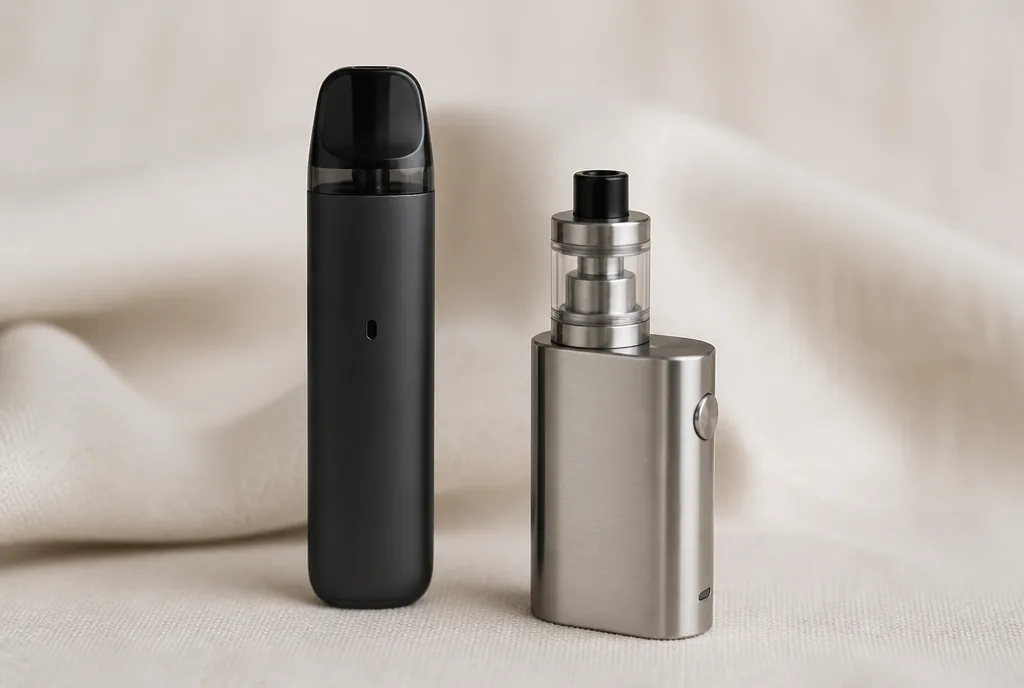 Hardware