Heisenberg e-liquid: story of a UK standard
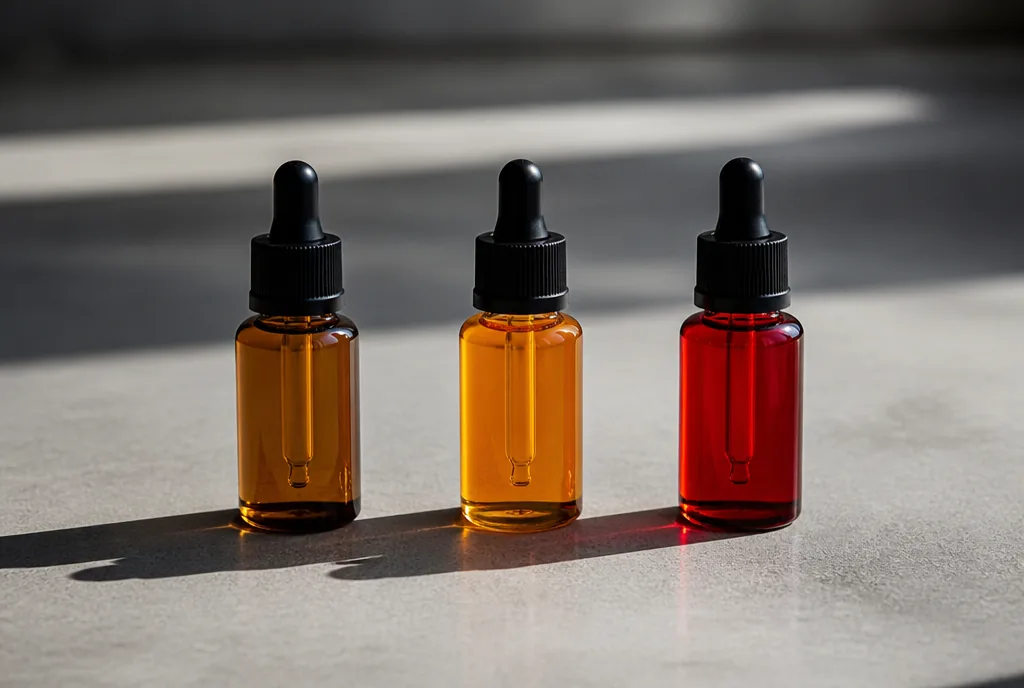
Few products in vaping have seen their name leave their brand and become a category. Heisenberg e-liquid is one of the very few that did. Ask for a Heisenberg in a British shop and the assistant will understand a profile rather than a specific reference: you will be shown several bottles, from several manufacturers. That slide from trade mark to common noun almost never happens here, and it is worth telling, because it says a great deal about how this market was built.
Heisenberg e-liquid is a British recipe from May 2014
Heisenberg e-liquid is a recipe from the British brand Vampire Vape, with a creation date of May 2014 and an origin in the United Kingdom. Its profile pairs a fruity sensation of mixed berries with a menthol note.
Those are the only elements officially communicated. The exact composition has never been published, and that has been a deliberate choice by the maker since the first batch.
British retailers routinely add aniseed to the description, and the brand itself now talks about a cool blue fruit character with icy menthol and subtle aniseed. Those are retail and marketing descriptions rather than a disclosed formula, and they are worth reading as such.
Vampire Vape, the house the recipe came from
Understanding the product means placing the company that formulated it, because its positioning partly explains the nature of the recipe. The brand is not a historic manufacturer, but it arrived at the right moment.
Vampire Vape was founded in 2012 in Blackburn, Lancashire, by Phil Boyle and Nat Walton. It grew on two parallel activities: ready to vape e-liquids, and concentrated flavourings intended for home mixing.
That double role had a direct consequence on how the recipe spread. The profile existed from the outset as a finished bottle and as a concentrate, therefore in both buying channels at once.
Philip Boyle runs Flavour Warehouse LTD, the company that markets the brand, and Nathan Walton runs Vampire Vape. Both men described the genesis of the product in an interview published by Vaping Post, which is the source of most of the dated elements repeated here.
A launch at Vape Fest in the summer of 2014
The context of the release counts as much as the recipe. In 2014 the e-liquid market was still dominated by single flavours, strawberry, cherry, apple, and by simple pairings of two fruits.
Nathan Walton describes that gap precisely: no brand had then developed genuinely complex flavours. Heisenberg and its twin product Pinkman were conceived to occupy that empty space, with an assembly of berries, menthol and secondary notes.
The launch took place outdoors, at the British Vape Fest of summer 2014. Phil Boyle recounts that the first batch went so fast that production had to run around the clock to avoid a stockout, and that part of it is still kept by the company.
A recipe that has not moved since launch
This is the most remarkable point in the file, and the hardest to hold over twelve years. Both directors state that neither the recipe nor the manufacturing process has changed since 2014.
The only shift concerns scale. Production moved to high volume and semi automated lines, with ISO 9001 accreditation obtained along the way. The manufacturer presents that consistency as the main reason for the commercial longevity of the product.
That stability has a rarely noted side effect: it makes the Heisenberg a yardstick. A vaper who tasted it in 2015 and comes back to it today has a fixed point of comparison, which is rare in a sector where ranges are reformulated constantly.
How a Heisenberg became a common noun
The move from product name to category name happened with no campaign, purely through use. Three mechanisms stacked up.
The first is the availability of the concentrate. By selling the flavouring in 10 and 30 ml bottles, the brand put the profile in the hands of everyone who mixes their own liquids, with an indicative dose of around 15 per cent in a balanced base and a steeping period of a few days before use.
The second is the absence of a published recipe. A profile nobody can copy exactly lends itself to interpretation: each manufacturer offers its own take on the berries and menthol assembly, without ever reproducing the original.
The third is the way shops adopted the vocabulary. British retailers file this kind of recipe under fruit and menthol, a category that had no obvious flagship before 2014. The product ended up naming its own family, and rival versions with deliberately close names now sit on the same listing pages.
A word on the name itself, often commented on. Retailers systematically link it to the alias of the central character in Breaking Bad, broadcast in the same period. The founders did not address that point in the interview cited, so that reading remains an outside attribution.
The Heisenberg e-liquid family today
A profile that becomes a standard eventually appears in every format on the market. The current British range gives a good overview, formats and ratios included.
- Ready to vape 10 ml bottles, in 50/50 and other ratios depending on the nicotine strength chosen, capped at 20 mg/ml.
- A 100 ml shortfill, nicotine free and heavily glycerine weighted, meant for sub ohm hardware.
- Nic salts versions, offered at 10 and 20 mg/ml in 10 ml bottles.
- Concentrate for home mixing in 10 and 30 ml.
- Prefilled 2 ml pods, a format set by British capacity rules.
That spread of ratios on a single recipe deserves emphasis. A profile formulated in 2014 for mouth to lung hardware had to be declined in a very glycerine heavy version to stay compatible with the sub ohm tanks that appeared afterwards, a constraint that every old recipe on the market has faced.
The shortfill format is the specifically British part of that story. Because nicotine containing bottles are capped at 10 ml here, the large bottle ships nicotine free with headroom, and a nic shot is added at home to reach the strength wanted. Anyone buying the 100 ml version is buying the profile, not the strength.
Frequently asked questions
Does the concentrate give exactly the same result as the finished bottle?
Rarely identical. The outcome depends on the base used, the dose chosen and the steeping time, whereas the ready to vape bottle comes off a standardised production line.
Why is this liquid blue?
The tint comes from the colouring of the recipe and has no bearing on the taste. It mainly works as instant visual identification on a shop shelf.
Is there a version without the cooling?
Not from the original maker. The menthol note is an integral part of the assembly, and removing it would amount to a different recipe.
Does the 100 ml shortfill contain nicotine?
No, like every large format on the British market. It is completed with a nic shot, which slightly alters the final ratio of the mix.
Does this profile suit mouth to lung hardware?
Yes, provided you pick a ratio rich in propylene glycol, typically the 50/50 in a 10 ml bottle. The heavily glycerine weighted versions are designed for low resistance coils and give a softer throat hit.
What the Heisenberg story says about the e-liquid market
Retracing the path of Heisenberg e-liquid since May 2014 amounts to watching the moment e-liquids stopped being single flavourings and became compositions. A recipe kept secret, a concentrate placed in everyone’s hands, and an entire category that ends up carrying the name of one product: the mechanism is the same one that pushed other pieces of hardware into everyday vocabulary, as the history of the interchangeable coil and its pioneers shows.
A standard, in this sector, is recognised less by its sales than by the number of manufacturers trying to get close to it, and Heisenberg e-liquid passes that test comfortably. The same reading applies to hardware, where a shared platform outlives an isolated model, and where the family tree of the atomiser explains far more than any specification sheet. If you want to see that logic applied to a single device, the Voopoo Drag X3 is a clean example.
Editorial content for adult readers only. Vaping is for over 18s in the United Kingdom. Nicotine containing e-liquids contain nicotine, a substance that causes addiction. This article is not a buying recommendation.
Further reading
Zeus clearomiser: the Geekvape range explained
The Geekvape Zeus clearomiser examined: where the name came from, the successive versions, the top airflow principle and its place in tank history. Hardware
 Voopoo Drag X3: nine years of the Drag range
The Voopoo Drag X3 placed in nine years of Drag history: what each generation brought, and what survived all the way through to this model. Hardware